
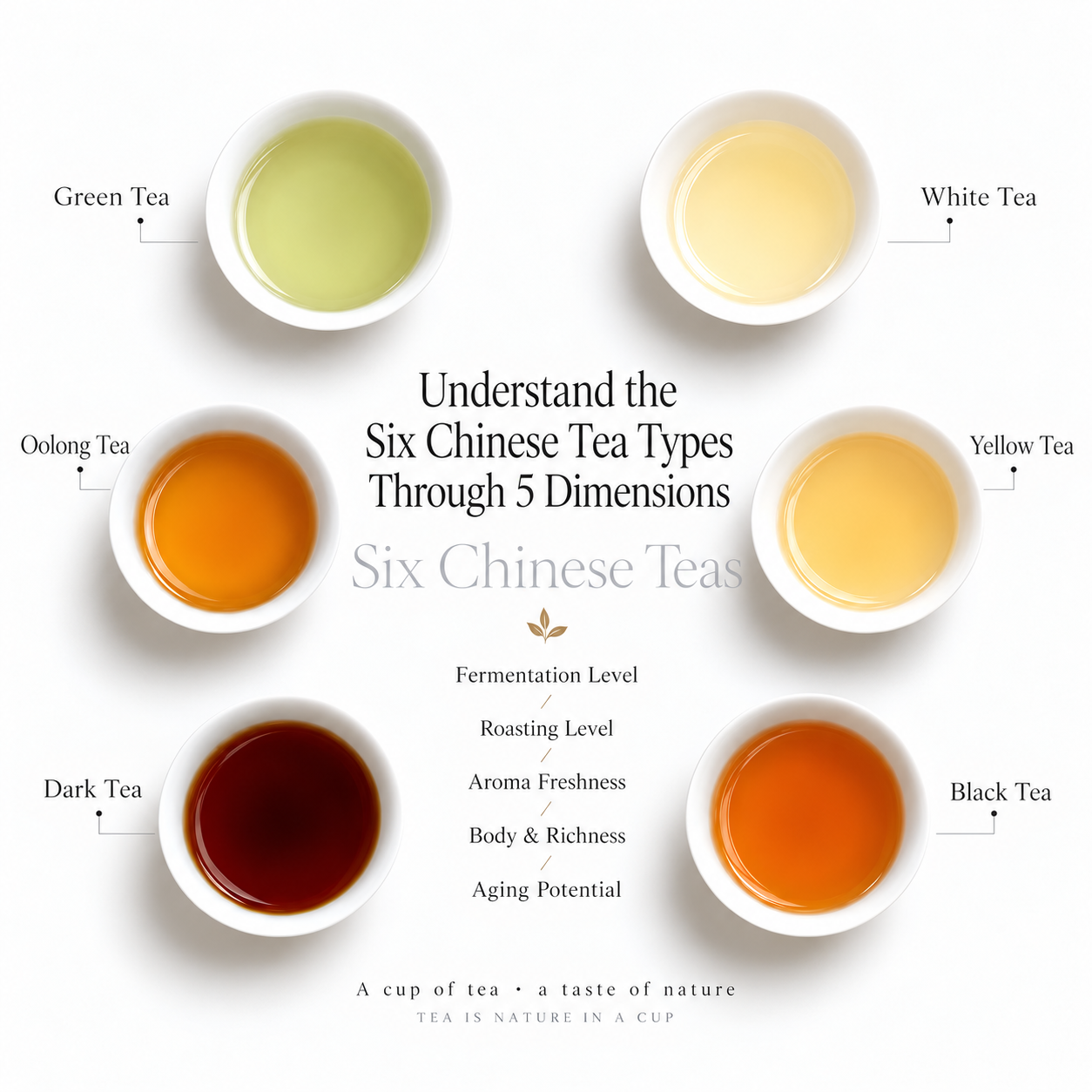
Walk into a Chinese tea shop and the labels may give you mountains, harvest years, tree ages and poetic names before they tell you what the tea tastes like. Start with the cup instead: decide whether you want something fresh, floral, rich, roasted or aged, then use the tea category to narrow the choice.
Green, white, yellow, oolong, black and dark tea all come from the same tea plant. Processing turns those leaves in different directions, while origin, cultivar and harvest shape the individual result.
What Is Chinese Tea?
In the strict sense, tea is made from the leaves and tender shoots of Camellia sinensis. The international tea classification standard does not include herbal or fruit infusions in this definition, even though products such as chamomile and peppermint are commonly called tea in everyday English.
Green, white, yellow, oolong, black and dark teas can all begin with the same plant. Their differences come from cultivar, growing environment, harvest and, most importantly, the sequence of processing steps used after the leaves are picked.
The phrase Chinese tea does not describe one flavor. It covers thousands of regional styles, from fresh spring green teas and fragrant oolongs to mellow black teas and aged Pu-erh. The six-category system is therefore a map, not a ranking.
The Six Types of Chinese Tea
The ISO classification of tea recognizes six basic types according to their characteristic processing methods. Learning these categories gives beginners a useful way to predict broad flavor directions, but every category still contains many different styles.
Green Tea
Green tea is heated relatively early in production to stop most enzymatic oxidation. Chinese producers commonly use pan-firing, although processing varies by region and style.
The cup may be fresh, vegetal, nutty, sweet or lightly toasted. Some green teas are brisk and grassy, while others are soft and chestnut-like, so green tea should not be treated as a single flavor.
Freshness matters more for green tea than it does for many heavily oxidized or aged teas. When buying, look for a harvest season or production year and begin with a smaller amount that you can finish while its aroma is still lively.
White Tea
White tea is made mainly through withering and drying. It is often described as minimally processed, but that does not mean the leaves receive no skilled handling or that every white tea tastes delicate.
Young white tea can suggest flowers, fresh hay, melon or gentle sweetness. With suitable material and storage, some styles may develop deeper honeyed, dried-fruit or herbal qualities over time.
White tea can be approachable for beginners because many examples are soft in texture. It should not, however, be advertised automatically as caffeine-free or as the lowest-caffeine choice, because caffeine depends on the leaf material and the way it is brewed.
Yellow Tea
Yellow tea begins with a heating step similar to green tea and then undergoes a controlled yellowing process in which the leaves are kept warm and covered. This additional step can soften some of the sharper green characteristics.
It is less common and often more expensive than the other major categories. A beginner does not need yellow tea to understand the basics, but it is useful because it shows how one added processing stage can noticeably change aroma, color and texture.
Oolong Tea
Oolong is a broad category built around withering, bruising or tumbling, partial oxidation, heating and drying. Producers can also roast the finished leaves, which creates another layer of variation.
Lightly oxidized oolongs may be creamy, green and floral. More oxidized or roasted examples may suggest ripe fruit, honey, minerals, warm spice or toasted grain.
Oolong is a helpful category for aroma-focused drinkers. Someone who enjoys jasmine-like fragrance may prefer a greener Tie Guan Yin, while a person looking for fruit, roast or mineral structure may prefer Phoenix Dancong or Wuyi rock tea.
Black Tea—or Red Tea in China
What English speakers call black tea is called hong cha, or red tea, in China. The English name refers to the dark dry leaves, while the Chinese name refers to the reddish color of the brewed liquor.
Black tea is allowed to oxidize much further than green tea before drying. Chinese examples can be malty, fruity, honeyed, floral, cocoa-like or gently smoky, depending on the material and production style.
This category can be a comfortable bridge for people who already drink English breakfast tea. Whole-leaf Chinese black teas are often enjoyable without milk or sugar, allowing the drinker to notice their natural sweetness and aroma.
Dark Tea and Pu-erh Tea
Dark tea, or hei cha, involves post-fermentation in which microbial activity contributes to changes in the leaves. It is not the same category as the oxidized tea called black tea in English.
Pu-erh is associated with Yunnan and is commonly discussed within the broader world of dark or fermented teas. Raw Pu-erh and ripe Pu-erh should still be distinguished because their production and flavor development follow different paths.
Raw Pu-erh can be floral, herbal, fruity, bitter-sweet or mineral when young and may change gradually with storage. Ripe Pu-erh goes through an accelerated fermentation process and is usually darker, rounder and more immediately approachable, with profiles that may suggest wood, dates, cocoa or aged aromatics.
Age alone does not make a Pu-erh good. The original material, processing and storage conditions all matter, which is why a clear storage history is more useful than a large vintage number by itself. For a deeper explanation, see TAYUNE’s guide to what Pu-erh tea is.
The table below keeps the six-category map intact while separating raw and ripe Pu-erh, because they lead to very different buying and drinking experiences.
| Tea type | Common flavor direction | Key processing | Start here when you want… |
|---|---|---|---|
| Green tea | Fresh greens, toasted chestnut, beans | Heated early to limit oxidation | A crisp, refreshing cup |
| White tea | Melon, fresh hay, flowers, honey | Withered and dried | Soft sweetness with little roast |
| Yellow tea | Mellow greens, grain, gentle sweetness | Fixed, then covered for yellowing | A softer and rarer alternative to green tea |
| Oolong tea | Flowers, cream, ripe fruit, minerals, roast | Partially oxidized; sometimes roasted | High aroma and changing infusions |
| Chinese black tea | Malt, dark fruit, honey, cocoa | Extensively oxidized | A rich, familiar cup without needing milk |
| Raw Pu-erh | Apricot, herbs, minerals, bitter-sweet finish | Sun-dried base tea that changes with storage | Structure, energy and evolving infusions |
| Ripe Pu-erh | Wood, dates, cocoa, aged aromatics | Wet-piled microbial fermentation | A dark, smooth and rounded cup |
How to Choose Chinese Tea by Flavor
If you enjoy fresh, clean and vegetal flavors, begin with a Chinese green tea. Look for descriptions such as chestnut, bean, spring greens or light florals rather than choosing only by the fame of the tea’s name.
If you prefer soft sweetness and a lighter texture, try a young white tea. If you want honeyed or dried-fruit depth, an older white tea may be more suitable, provided the seller explains its age and storage.
If fragrance is your priority, oolong offers the widest field to explore. Greener styles often emphasize flowers and creaminess, while roasted or more oxidized styles can provide fruit, minerals and warmth.
If you want a familiar, full-flavored cup, Chinese black tea is a practical starting point. It can provide the body associated with conventional black tea while introducing clearer fruit, honey and floral notes.
If you enjoy darker, smoother or more aged profiles, try ripe Pu-erh. If you are comfortable with bitterness, changing infusions and a more structured finish, raw Pu-erh may offer a more revealing learning experience.
Think of tasting notes as reminders rather than rules. If a label mentions orchid, it points to a natural floral lift in the leaves; it does not mean someone added flowers or sprayed perfume on the tea.
What to Look for When Buying Chinese Tea
A useful product listing should identify more than a poetic name. Look for the tea type, region, harvest or production year, net weight, format, storage information and practical brewing guidance.
Specific information is usually more valuable than grand claims. A description such as spring 2026 Phoenix Dancong from Wudong gives the buyer something that can be checked, while phrases such as supreme imperial tea or miracle ancient-tree tea provide little help without evidence.
Freshness and age should be judged differently. A spring green tea is generally bought for fresh aroma, while a well-stored Pu-erh may be selected partly for the way it has developed over time.
Spend first on contrast, not prestige. Three well-chosen samples will teach you more than one expensive cake bought for its famous mountain name.
Good tasting notes should give you a direction, then leave room for your own water and brewing method. If every product is described as rare, sweet, smooth and complex, the descriptions are not helping you choose.
Once opened, most non-aged teas belong in a sealed container kept cool, dry, dark and away from strong odors. Pu-erh intended for aging follows different storage rules, so use guidance written for that particular tea rather than treating it like fresh green tea.
Tea Samples, Loose Leaves, or a Full Tea Cake?
Samples are usually the lowest-risk choice for a beginner. They make it possible to compare several categories and discover personal preferences before committing to a large quantity.
Loose leaves are convenient when you already know the style you want. They are easy to measure, require no tea knife and are suitable for both mug-style and small-vessel brewing.
A full Pu-erh cake makes more sense after you have tasted the tea or a closely related example. A cake can provide dozens of sessions, so a lower price per gram is not a bargain if you do not enjoy drinking it.
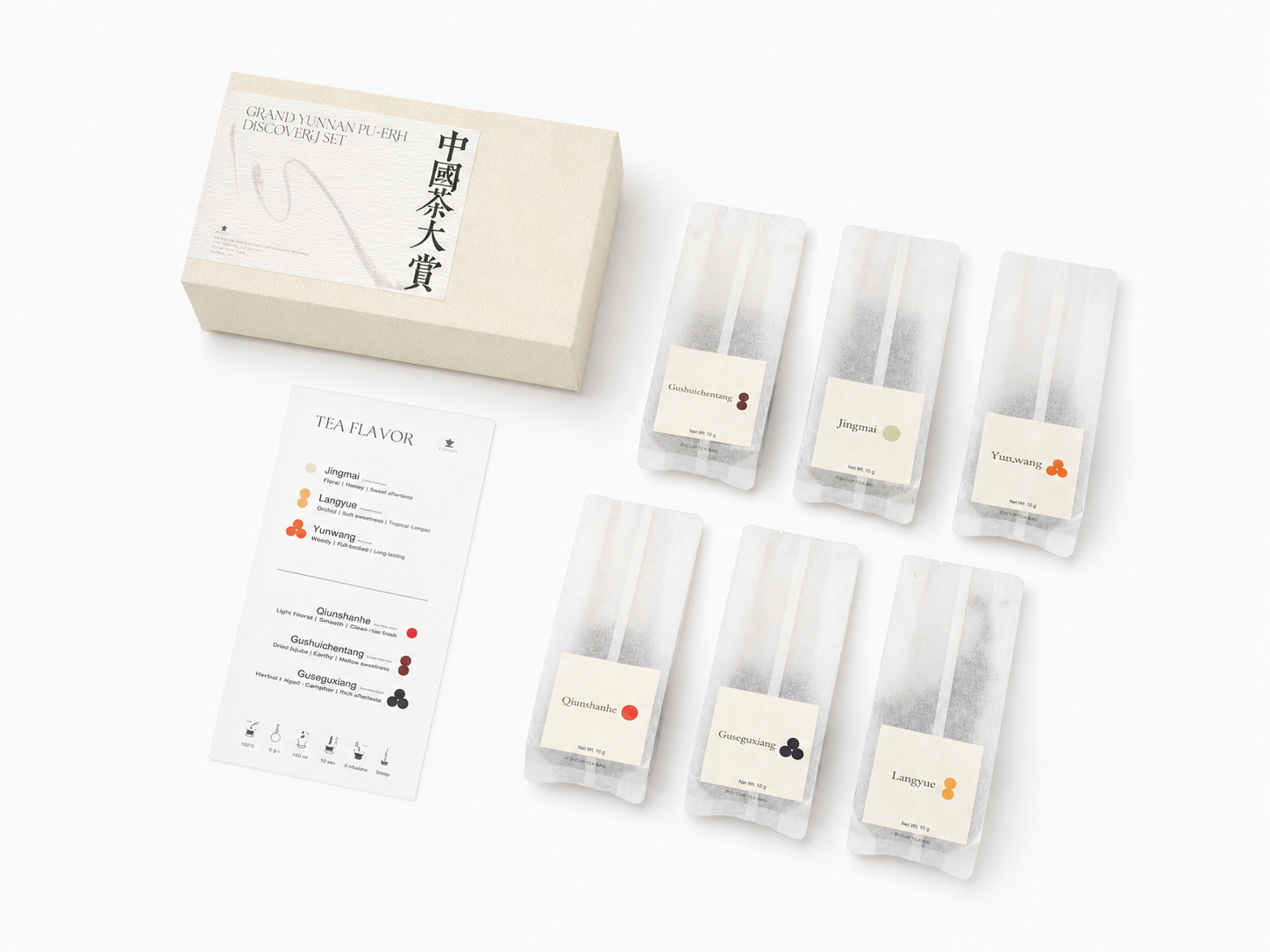
Sampling is especially useful with Pu-erh because raw and ripe styles can feel very different. A comparison set such as the Grand Yunnan Pu-erh Discovery Set lets a new drinker taste three raw and three ripe teas before selecting a full cake.
How to Brew Chinese Tea Without Complicated Equipment
You do not need a full tea table to begin. A mug or small teapot, a strainer, a kettle and a scale are enough to make repeatable tea.
For a general Western-style starting point, use about 2 grams of leaf for every 100 ml of water and steep for two to three minutes. This is only a baseline, because dense rolled leaves, delicate buds and broken leaves extract at different speeds.
Water temperature changes what comes out of the leaf. Cooler water can make delicate green and white teas gentler, while black tea, roasted oolong and dark tea often respond well to hotter water.
Gongfu-style brewing uses a smaller vessel, more leaf and a series of short infusions. Its main advantage is not ceremony; it allows the drinker to notice how aroma, texture and sweetness change from one infusion to the next.
If the tea tastes thin, add a little more leaf, extend the time or raise the temperature. If it tastes harsh, change only one variable by using cooler water, a shorter infusion or less leaf.
Keeping the same vessel and water while comparing teas makes differences easier to notice. More detailed ratios and troubleshooting are available in TAYUNE’s simple tea brewing guide.
Chinese Tea Culture Is Part of Everyday Life
Chinese tea culture is sometimes presented as one formal ceremony, but daily practice is much broader. Tea may be served at home, during business conversations, in restaurants, at family gatherings or simply while someone works at a desk.
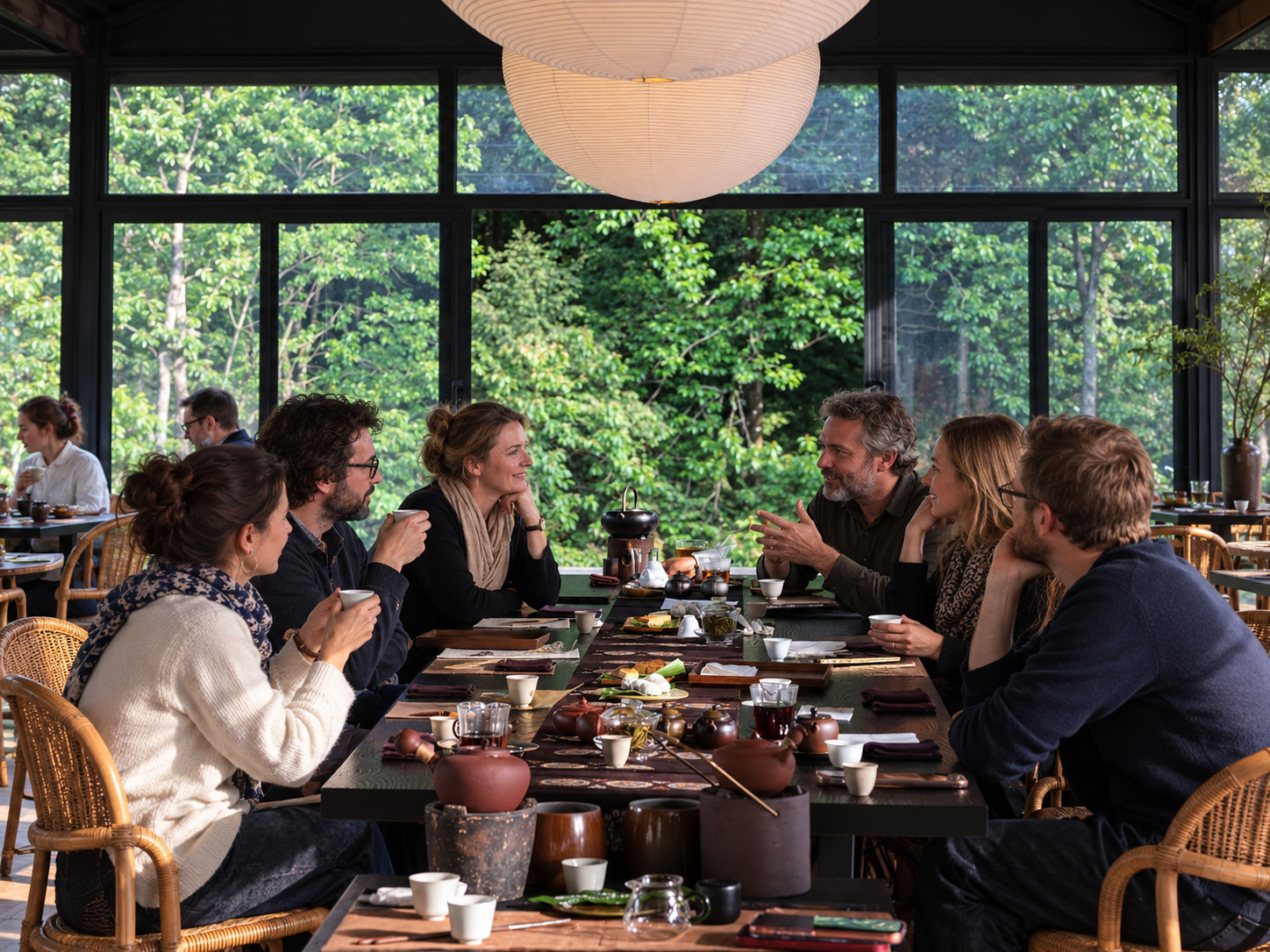
Serving tea is often an act of welcome. The vessel and movements may change between regions, but sharing tea creates time for conversation and gives attention to the guest.
Tea also has a documented history rather than only a legendary one. The story of Shennong discovering tea around 2737 BCE is a cultural legend, while archaeological research published in Scientific Reports has identified physical tea remains from roughly 2,100 years ago.
By the Tang dynasty, tea had become closely connected with literature, trade and social life. Lu Yu’s Classic of Tea, written around the eighth century, brought cultivation, preparation and appreciation into one systematic work.
In 2022, UNESCO added China’s traditional tea processing techniques and associated social practices to the Representative List of the Intangible Cultural Heritage of Humanity. Its description emphasizes planting, picking, processing, drinking and sharing, as well as tea’s role in hospitality and community life.
You do not need ceremonial clothing or a perfect sequence of movements to take part. Learn where the leaves came from, brew them with attention and pour a cup for someone else.
If You Are Coming to Tea from Coffee
Coffee usually delivers one concentrated brew; loose-leaf tea can stretch across several infusions and change as the session continues. The better choice depends on the taste and pace you want that day.
The FDA lists typical caffeine amounts for a 12-fluid-ounce serving at about 37 mg for green tea, 71 mg for black tea and 113–247 mg for regular brewed coffee. Treat those figures as ranges: changing the leaf or bean quantity, serving size and brewing time changes the final cup.
A coffee drinker looking for body may enjoy ripe Pu-erh or a robust Chinese black tea. Someone interested in roasted aroma may prefer Wuyi oolong, while a drinker who wants a lighter afternoon cup may find green or white tea easier to explore.
Tea leaves can often be infused more than once. Instead of producing one identical cup, repeated short infusions may reveal changing aroma, texture and aftertaste over the course of a session.
Choose between them by flavor, caffeine tolerance and routine rather than turning the decision into a health contest.
Your First Three Teas: A TAYUNE Starter Order
A practical first order from TAYUNE can cover three clearly different directions without asking you to buy a full Pu-erh cake.
- Start with the smallest pack of 2026 Wudong Phoenix Dancong — Dongfanghong. The 5.2 g × 2 option introduces the gardenia, peach and high-aroma side of Chinese oolong.
- Add the 60 g option of Yunnan Handmade White Tea. Its smooth texture and natural sweetness create a clear contrast with the brighter Dancong.
- Choose the 20 g sample of 2015 Bulang Mountain Ripe Pu-erh — Chenxiang. It introduces a darker liquor, silky body and clean aged aroma without committing to a 357 g cake.
If your main interest is Pu-erh, the Grand Yunnan Pu-erh Discovery Set is the more focused first purchase: its six labelled 10 g servings let you compare three raw and three ripe teas in the same format.
Brew them with the same water and equipment. Record only a few observations: aroma, bitterness or astringency, body, sweetness and the feeling left after swallowing.
Do not worry about identifying rare tasting notes. A simple preference such as lighter, more floral, smoother or more roasted is already enough to guide the next purchase.
After identifying a category you enjoy, try two or three examples within it. This teaches more than buying a large amount of a famous tea before you know what you like.
The goal of a first purchase is not to find the best tea in China. It is to find the next tea you genuinely want to brew.