
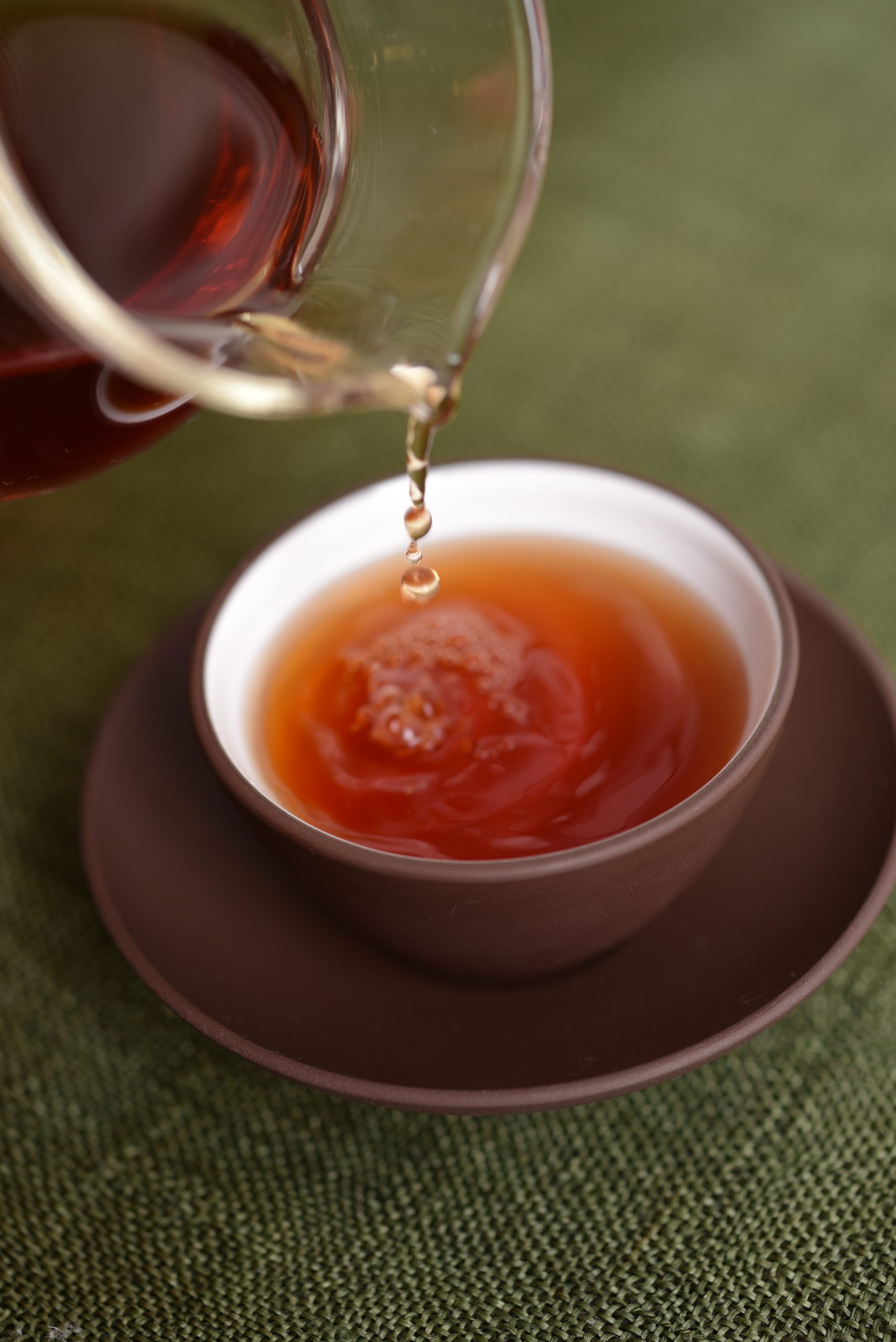
To store a Pu-erh tea cake at home, keep its clean paper wrapper and place it in an odor-free container in a shaded cupboard. Protect it from dampness, heat and household smells, and check the tea periodically. Choose the container for your local climate: an open cardboard box can dry tea out in a dry home or admit too much moisture in a humid one. Long-term aging needs more monitoring than storing a small amount for daily drinking.
Aging can change a tea, but better flavor is not guaranteed. This guide focuses on keeping your tea in good condition while those changes take place.
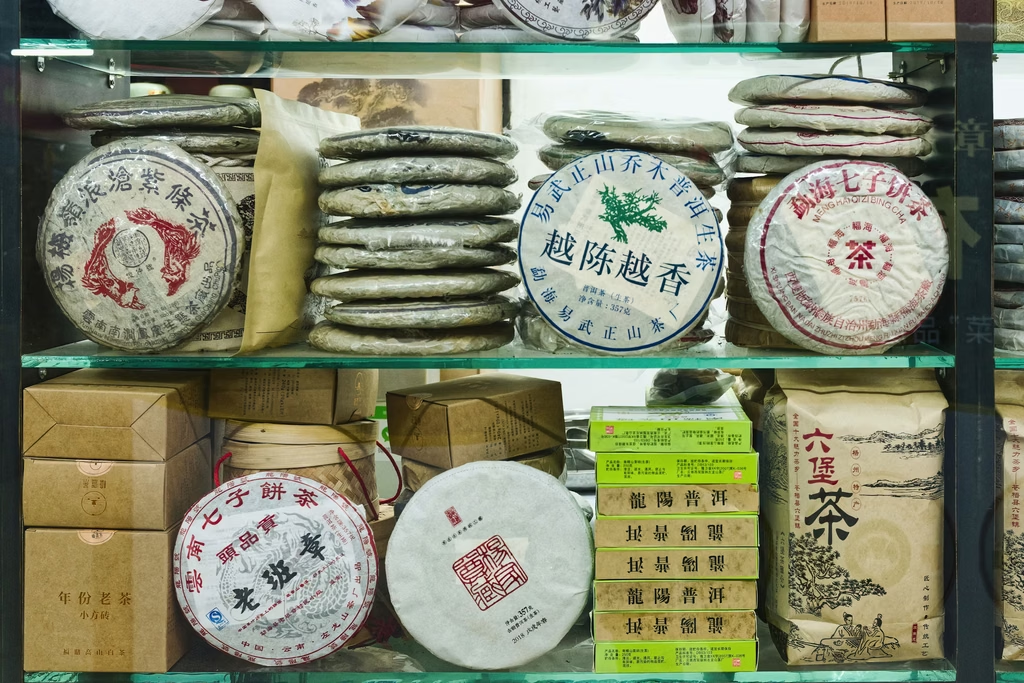
How you store a Pu-erh tea cake can have a major influence on how it develops.
Too much moisture can encourage mold. Extremely dry conditions may slow down the transformation of the tea. Strong odors can be absorbed by the leaves, while heat and direct sunlight can damage the tea’s character.
Fortunately, storing Pu-erh at home does not need to be complicated.
The basic principle is simple:
Keep Pu-erh tea in a clean, shaded, odor-free environment with stable conditions, and choose packaging that protects it from excessive moisture or drying.
This guide explains how to store Pu-erh tea cakes properly, whether you plan to drink them within a few months or age them for many years.
Pu-erh Storage at a Glance
| What to check | Practical home-storage approach |
|---|---|
| Wrapper | Keep the clean, dry paper wrapper; replace damaged wrapping with clean, food-safe, odorless paper. |
| Container | Use a clean, odor-free container suitable for food or tea. Choose how tightly it closes according to your climate. |
| Air exposure | Keep cakes covered and away from fans or drafts. Continuous open airflow is not required. |
| Humidity | Monitor conditions near the tea; prevent dampness and condensation. One room-humidity number cannot guarantee safe storage. |
| Location | Use a shaded indoor cupboard away from kitchens, bathrooms, heaters and strong smells. |
| Inspection | Check for damp wrappers, unusual growth and persistent musty smells; do not taste suspect tea to test it. |
Why Does Pu-erh Tea Need Special Storage?
Fresh green tea is commonly stored to preserve its fresh character. Pu-erh is often stored with gradual flavor development in mind, although it is not the only tea that people choose to age.
Pu-erh is different.
Pu-erh, especially raw Pu-erh (Sheng Pu-erh), can continue to evolve after it has been compressed into a tea cake. Over time, chemical and microbial changes gradually affect its aroma, bitterness, sweetness, mouthfeel, and overall character.
Young raw Pu-erh may initially taste fresh, strong, bitter, or slightly astringent. With suitable aging, some teas can gradually become softer, rounder, and more complex.
Ripe Pu-erh (Shou Pu-erh) has already undergone an accelerated fermentation process before being sold. Its transformation during storage is usually less dramatic than raw Pu-erh, but good ripe Pu-erh may still become smoother and cleaner over time.
This is one reason Pu-erh is sometimes compared with wine.
A good wine needs suitable cellar conditions to age well. Pu-erh also needs the right environment if you want time to improve rather than damage the tea.
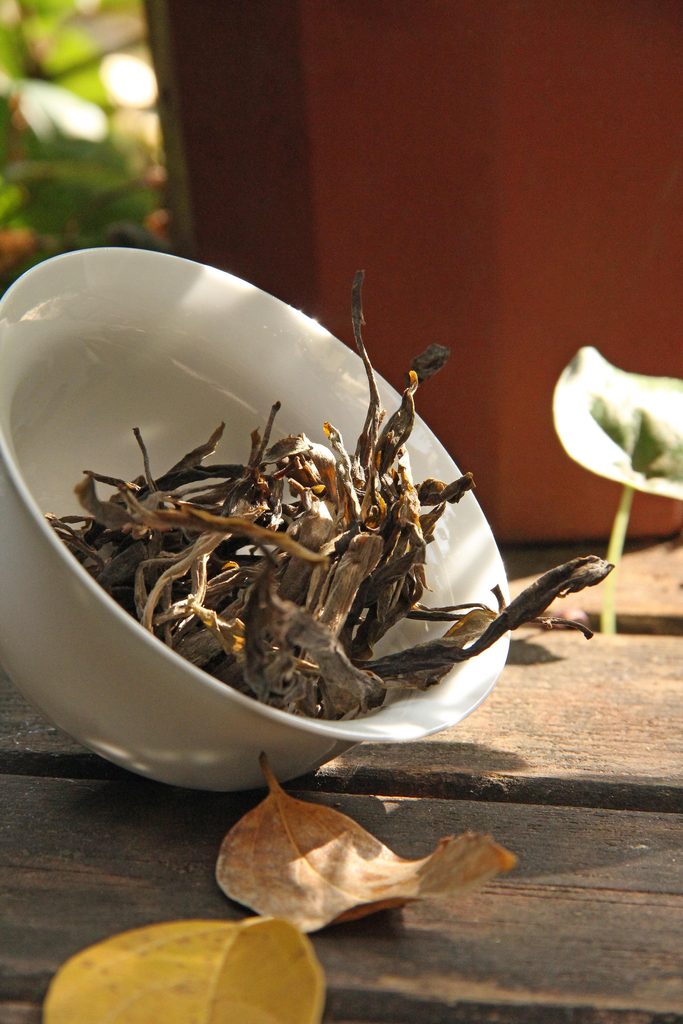
The 3 Most Important Conditions for Storing Pu-erh Tea
You do not necessarily need a professional tea warehouse to store Pu-erh successfully.
Start with three basics: avoid strong odors, protect the tea from sunlight, and control moisture.
1. Keep Pu-erh Away From Strong Odors
This may be the most important rule.
Tea leaves easily absorb smells from the surrounding environment. If a Pu-erh cake is stored near perfume, incense, spices, cigarettes, cleaning products, cooking oil, or other strongly scented items, those odors may eventually become part of the tea.
For this reason, avoid storing Pu-erh in:
- Kitchens
- Bathrooms
- Garages
- Cabinets containing chemicals
- Closets with perfume or cosmetics
- Areas exposed to cigarette smoke
- Refrigerators containing food
A clean cupboard, shelf, tea cabinet, or dedicated storage box is usually much better.
If you own a valuable Pu-erh collection, keeping the tea in a dedicated storage area is worth considering.
2. Protect the Tea From Direct Sunlight
Pu-erh should generally be stored in a dark or shaded environment.
Direct sunlight can heat the tea and expose it to ultraviolet light. Repeated temperature changes may negatively affect the aging environment, while long-term exposure can also influence aroma and flavor.
You do not have to keep Pu-erh in complete darkness, but avoid placing tea cakes:
- Beside a sunny window
- On an open shelf receiving direct afternoon sun
- Inside a hot vehicle
- Near heating equipment
A closed cabinet or covered storage box usually provides sufficient protection.
3. Maintain Moderate Humidity
Humidity is one of the most discussed topics in Pu-erh storage.
Pu-erh generally develops better when the environment is not excessively dry, because some moisture in the air supports the slow processes involved in aging.
However, more humidity does not mean better aging.
Excessive humidity can encourage mold, unwanted odors, and unpleasant fermentation.
There is no single humidity target that works for every home, container and tea. Temperature, packaging and moisture already present in the leaves affect the result; a room-humidity reading alone cannot establish whether a cake is safely stored.
The exact ideal level depends on temperature, airflow, climate, and how the tea is packaged. More important than chasing a precise number is avoiding extremes.
During humid weather, keep moisture from accumulating around the tea. Opening a container to very humid room air can make the situation worse; inspect the storage conditions before changing ventilation.
Damp wrappers or condensation are reasons to act immediately, whatever the hygrometer reads. Do not add water directly to tea or its wrapper to speed up aging.
On the other hand, extremely dry environments may cause the tea to age very slowly and can sometimes make the leaves feel dry or the aroma less expressive.
A small digital hygrometer is an inexpensive and useful tool if you plan to store Pu-erh for several years.
What Temperature Is Best for Pu-erh Tea Storage?
Pu-erh does not require refrigeration.
For most home collectors, a comfortable indoor temperature is suitable.
There is no single temperature that guarantees good aging. A stable indoor location is a practical starting point:
Choose a cupboard away from direct sun and heat sources, and check for large seasonal changes in temperature and humidity.
Slightly warmer conditions can accelerate transformation, while cooler environments generally slow it down.
The most important factor is stability.
Avoid locations where temperatures change dramatically throughout the day.
For example:
- Next to an oven
- Above a refrigerator
- Beside a heater
- Inside an attic
- In direct sunlight
- In a hot garage
Heat combined with high humidity is especially risky because it can encourage unwanted microbial growth.
For long-term storage, a stable room-temperature environment is usually preferable to constantly changing conditions.
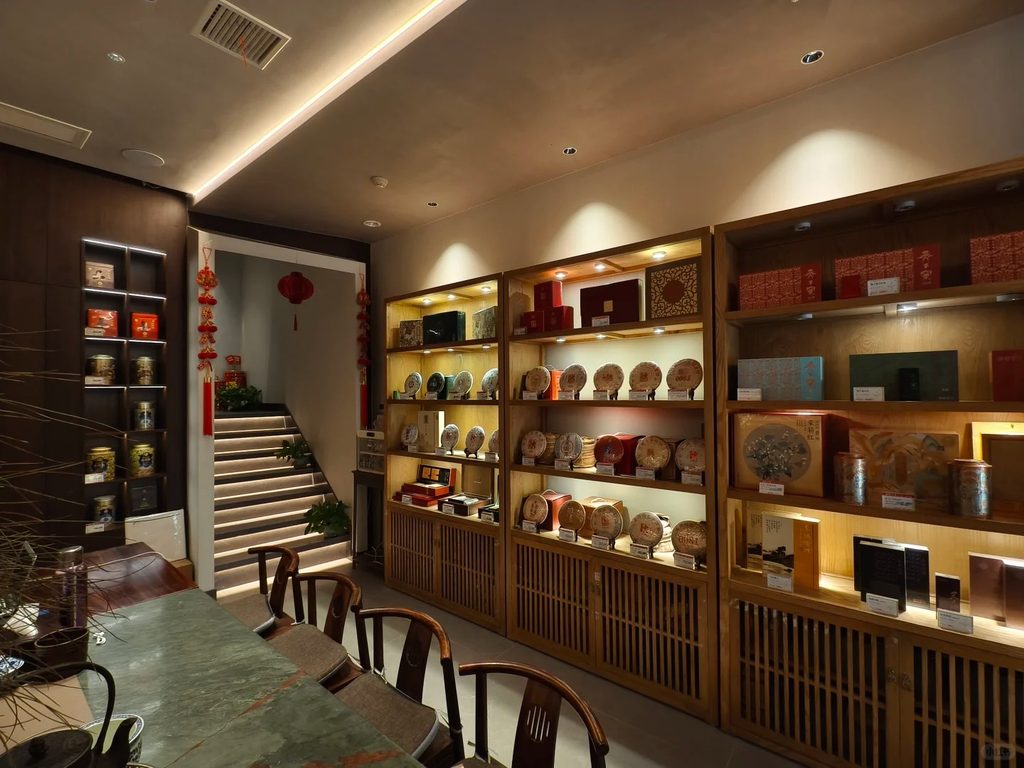
Does Pu-erh Tea Need Airflow?
Pu-erh does not need to sit exposed to moving air. Too much exposure can dry the leaves and let aromas escape. The practical aim is to protect the tea while managing moisture in the environment immediately around it.
A paper wrapper inside a clean box or cabinet can work in a suitable climate. In a very dry home, a food-safe, odor-free container that closes more tightly may help retain moisture and aroma. In a humid home, closing damp tea inside a container can trap the problem. Check that the tea and packaging are dry and monitor the conditions.
There is no universal rule that all airtight storage is wrong or that all breathable storage is better. Choose the setup for your climate, how often you open the tea, and whether you are storing it for daily drinking or long-term aging.
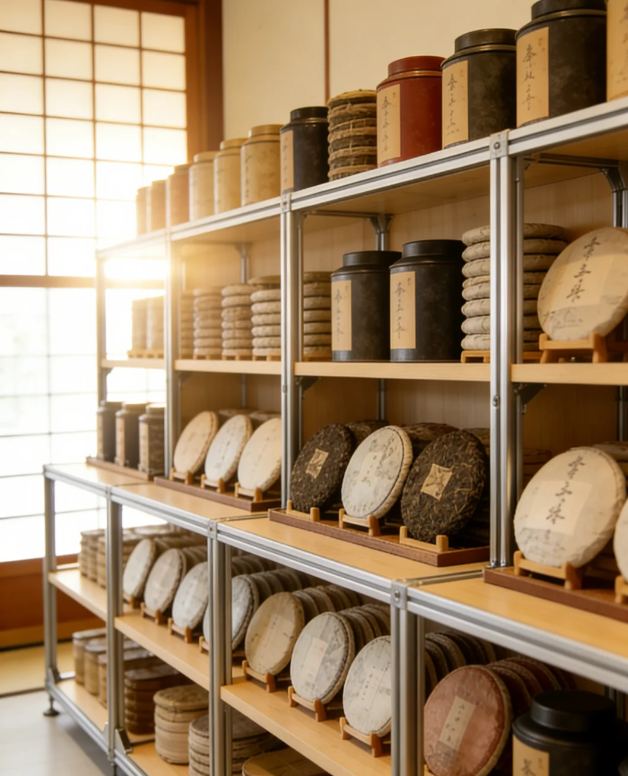
Should You Keep Pu-erh Tea in Its Original Wrapper?
In most cases, yes.
Traditional Pu-erh cakes are wrapped in paper for a reason.
The paper protects the surface of the tea from dust and physical contact while still allowing the cake to interact with the surrounding environment.
If your Pu-erh cake comes with its original paper wrapper, there is usually no need to remove it during storage.
If several cakes come together inside a traditional bamboo wrapper, known as a tong, keeping them together may also help create a relatively stable microenvironment.
Avoid repeatedly handling unwrapped tea cakes with bare hands, especially if your hands contain perfume, lotion, oil, or food odors.

Can Pu-erh Tea Be Stored in the Refrigerator?
Generally, no.
Refrigeration is common for certain fresh green teas and some high-aroma teas, but it is usually unsuitable for Pu-erh.
A refrigerator creates several problems:
- Food odors can contaminate the tea.
- Condensation may form when cold tea is removed.
- The low temperature slows the aging process.
- Humidity conditions may fluctuate.
- The tea may absorb refrigerator smells.
Unless there is a very unusual reason, keep your Pu-erh at normal indoor temperature instead.
How to Store Pu-erh Tea Cake at Home
You can create a simple Pu-erh storage system without expensive equipment.
A practical home setup might look like this:
Step 1: Choose a Clean Location
Select a cupboard, shelf, closet, or cabinet away from kitchens, bathrooms, sunlight, perfume, smoke, and chemicals.
Step 2: Keep the Original Paper Wrapper
Leave each tea cake in its original breathable wrapper.
Step 3: Place the Tea in a Cardboard Box or Tea Cabinet
A clean, odor-free cardboard box is one option when the surrounding room conditions are suitable. Cardboard is not a moisture barrier: if your home is very dry or humid, use a more protective food-safe container and monitor the tea inside.
If you have several Pu-erh cakes, storing them together can create a more stable environment than leaving individual cakes exposed throughout the house.
Step 4: Add a Hygrometer
Place a small temperature and humidity meter near the tea.
You do not need to check it every hour. The goal is simply to understand whether your storage environment is generally stable.
Step 5: Inspect Your Tea Occasionally
Every few weeks or months, check your collection.
Look for:
- Unusual white, green, black, or fuzzy growth
- Strong musty odors
- Damp wrappers
- Insect damage
- Unusual condensation
Healthy aged Pu-erh may develop earthy, woody, sweet, herbal, camphor-like, dried-fruit, or other mature aromas depending on the tea.
A strong smell of damp basement, mildew, or obvious mold is different and should not be ignored.

Raw Pu-erh vs. Ripe Pu-erh Storage
Raw and ripe Pu-erh can generally be stored under similar environmental conditions, but many collectors prefer to separate them.
Why?
Ripe Pu-erh often has a stronger earthy or fermentation aroma, particularly when it is relatively young.
If raw and ripe Pu-erh are stored closely together for many years, some collectors believe their aromas may influence each other.
For a small collection, this may not be a major issue.
For serious long-term aging, however, it is reasonable to maintain separate boxes or storage areas for:
Raw Pu-erh (Sheng)
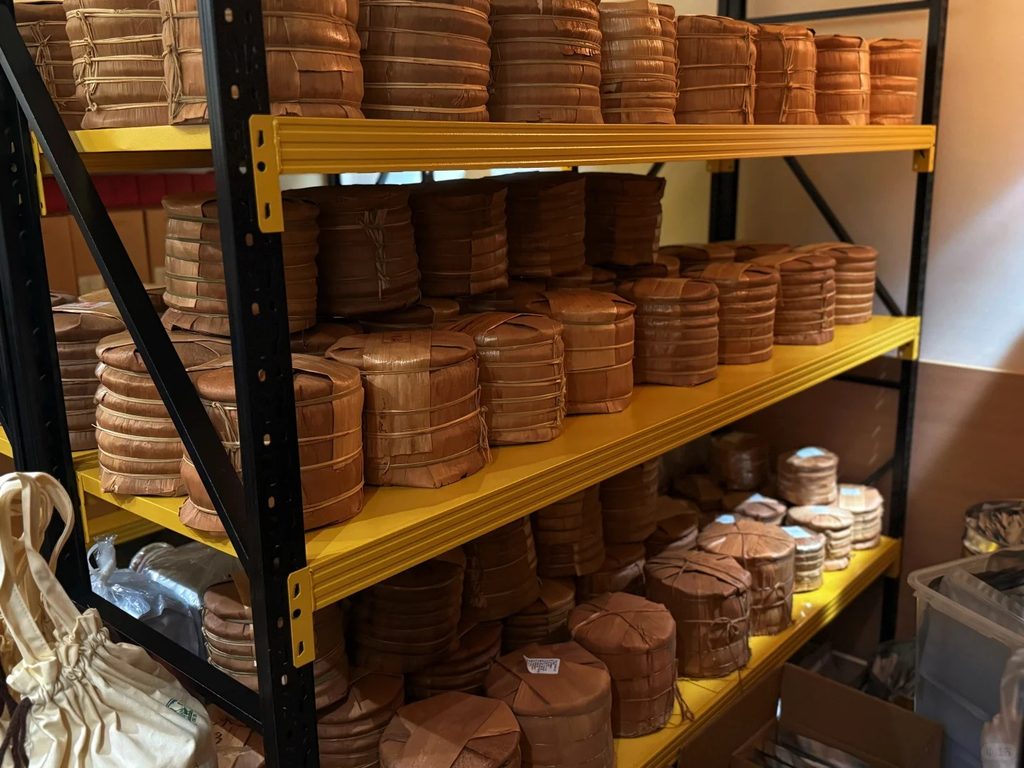
and
Ripe Pu-erh (Shou)
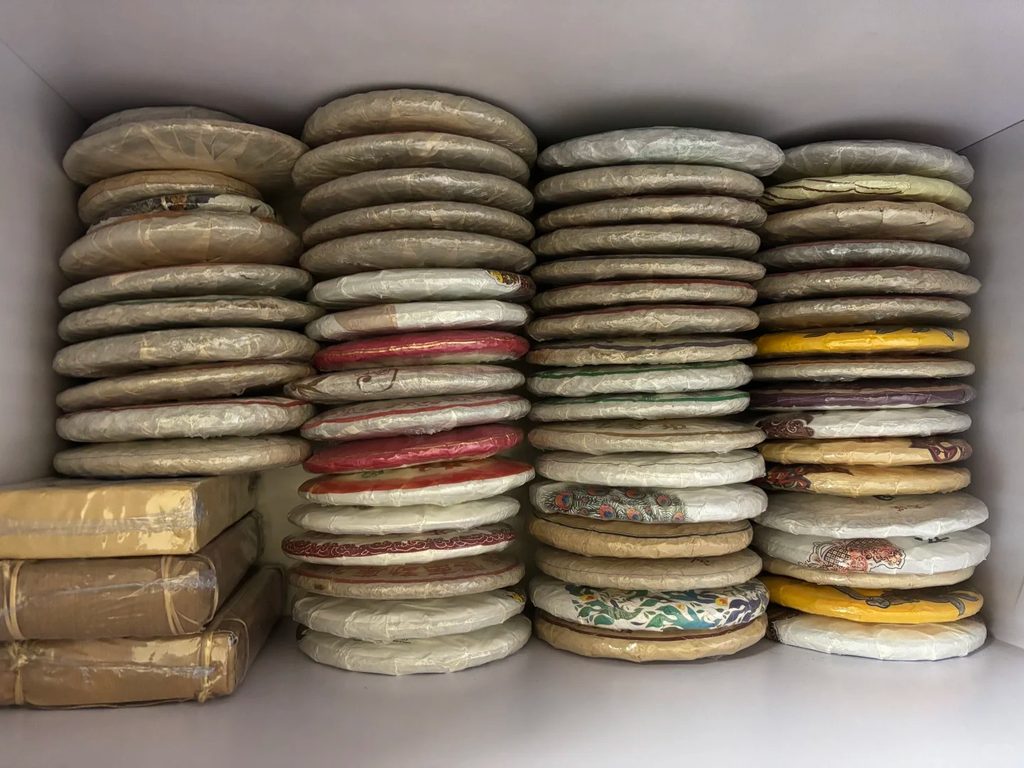
You may also choose to separate strongly scented teas from more delicate ones.
Dry Storage vs. Wet Storage
When researching Pu-erh, you may encounter the terms dry storage and wet storage.
They do not simply mean “dry tea” and “wet tea.”
Dry Storage
Dry storage generally refers to aging Pu-erh in relatively moderate humidity with good environmental control.
The transformation is usually slower.
Tea stored this way may retain more clarity and gradually develop mature characteristics over a longer period.
Wet Storage
Wet storage usually refers to intentionally exposing Pu-erh to higher humidity in order to accelerate aging.
This technique has historically been associated with certain traditional Pu-erh markets.
When carefully managed by experienced professionals, humid storage can create distinctive aged characteristics.
But uncontrolled high humidity can also create musty flavors, excessive fermentation, and mold.
For most beginners storing Pu-erh at home:
moderate, clean storage is the safer choice.
There is rarely a need to deliberately create very humid conditions just to make the tea age faster.

How Long Can You Store a Pu-erh Tea Cake?
Properly stored Pu-erh can potentially remain drinkable for decades.
However, that does not mean every Pu-erh should be stored for decades.
Some teas are enjoyable when young.
Some improve noticeably after several years.
Others may reach an attractive stage after 10, 15, or 20 years.
The result depends on:
- Tea leaf quality
- Production method
- Compression
- Storage environment
- Climate
- Personal taste
Aging Pu-erh is not simply about waiting for the highest possible number of years.
The goal is to follow how the tea develops and drink it when you enjoy it.
Does Pu-erh Tea Expire?
Pu-erh does not have one universal shelf life. Follow the producer’s storage and date guidance, and assess the condition and storage history of the tea rather than assuming an old cake remains suitable indefinitely.
Instead, its condition depends heavily on the storage environment.
A well-stored Pu-erh cake may remain enjoyable for many years.
A badly stored tea can be damaged relatively quickly.
Therefore, when evaluating old Pu-erh, storage history may be just as important as age.
A 20-year-old tea stored poorly is not automatically better than a 5-year-old tea stored carefully.
Common Pu-erh Storage Mistakes
Even good tea can be damaged by poor storage.
Storing Pu-erh in the Kitchen
Cooking oil, spices, smoke, and food aromas can easily contaminate tea.
Storing It in Direct Sunlight
Sunlight creates heat and can gradually affect the tea’s aroma and quality.
Using Extremely High Humidity
Trying to accelerate aging by adding too much moisture can result in mold.
Choosing Packaging Without Considering the Climate
Vacuum packing, tightly closed containers and open storage create different conditions. None guarantees good aging. Avoid choosing a method solely to make aging faster; protect the tea from dampness, odors and excessive drying.
Storing Tea Near Perfume or Incense
Pu-erh absorbs surrounding odors surprisingly easily.
Obsessing Over Exact Numbers
Temperature and humidity matter, but stability and cleanliness are often more important than maintaining one perfect number every minute of the day.
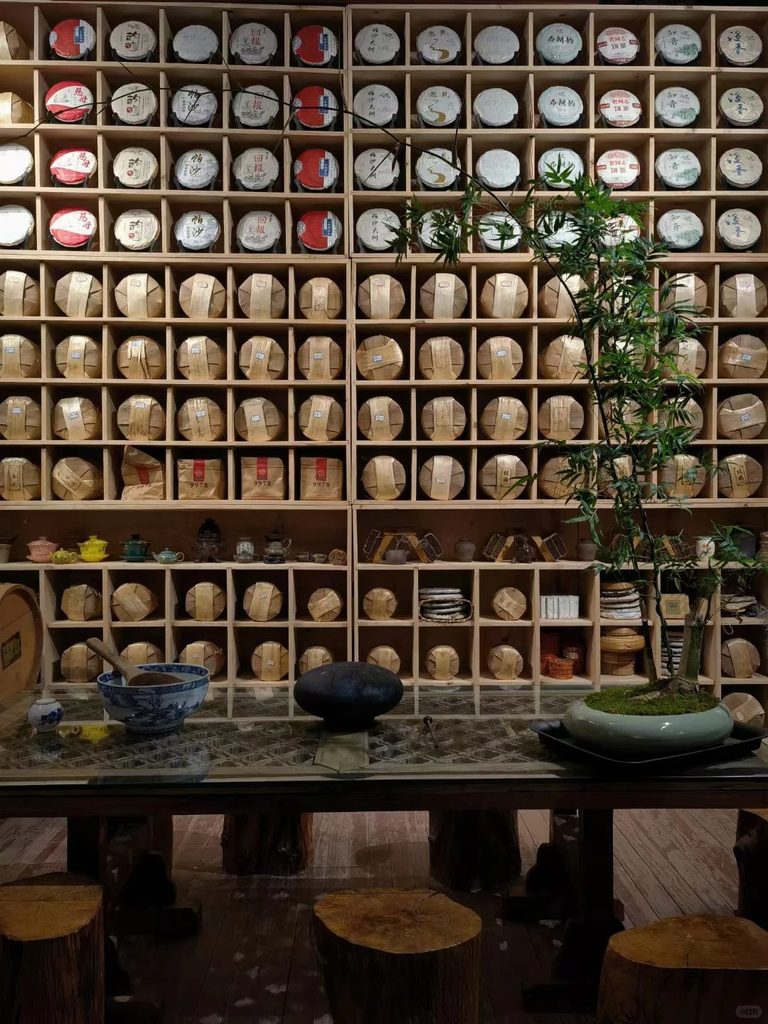
Can You Age Pu-erh Tea at Home?
Absolutely.
Many tea drinkers successfully age Pu-erh in ordinary homes.
You do not need a professional warehouse.
For most people, a good starting setup is simply:
Keep the original clean wrapper, use an odor-free container suited to your climate, place it in a shaded indoor cupboard, and monitor the tea and its storage conditions.
As your collection grows, you can invest in better humidity monitoring, dedicated cabinets, ceramic containers, or more advanced climate control.
But good Pu-erh storage begins with controlling the basics.
Final Thoughts
Storing Pu-erh tea is less complicated than it sometimes appears.
You do not need to create an artificial tropical environment or constantly adjust temperature and humidity.
What Pu-erh needs most is stability.
Keep your tea away from sunlight, strong odors, excessive moisture and major temperature changes. Choose packaging for your climate and inspect the tea periodically.
If the tea itself is good and the storage environment is suitable, time can slowly transform it.
A young Pu-erh cake may begin with strong bitterness, fresh aromas, and energetic character. Years later, that same tea may become softer, sweeter, deeper, and completely different from the tea you first purchased.
That slow transformation is one of the great pleasures of Pu-erh.
You are not simply storing tea.
You are giving the tea time to evolve.
Frequently Asked Questions About Pu-erh Tea Storage
What is the best way to store a Pu-erh tea cake?
Keep the tea in its original paper wrapper and store it in a clean, dark, odor-free place with moderate humidity and stable room temperature. A cardboard box, tea cabinet, or suitable ceramic container can work well.
What humidity is best for Pu-erh tea?
There is no universal ideal percentage. Temperature, packaging and the moisture in the tea all matter. Monitor conditions near the tea and prevent dampness and condensation; a seemingly moderate reading does not guarantee that a cake is safe.
Should Pu-erh tea be airtight?
It depends on the climate and the condition of the tea. A tightly closed, food-safe container can help in a dry home, while enclosing damp tea can trap moisture. Continuous open airflow is not a requirement.
Can I store Pu-erh tea in a ziplock bag?
A clean, food-safe, odor-free resealable bag can protect small portions or help limit drying. Keep the tea dry, protect the bag from heat and sunlight, and check it periodically. Packaging alone does not determine how well a tea will age.
Can I store Pu-erh tea in the refrigerator?
It is generally not recommended. Refrigerators contain food odors, create condensation risks, and provide conditions that are unnecessary for Pu-erh.
Should raw and ripe Pu-erh be stored separately?
They can be stored in the same general environment, but for long-term storage many collectors separate raw and ripe Pu-erh to reduce the possibility of aroma transfer.
How long should Pu-erh tea be aged?
There is no fixed answer. Some Pu-erh is enjoyable when young, while other teas may improve over 5, 10, 20 years or longer. Tea quality, storage conditions, and personal preference all matter.
How do I know if stored Pu-erh has gone bad?
Visible fuzzy growth, persistent mildew smells, damp wrappers or condensation call for caution. Do not drink suspect tea or assume rinsing makes it safe. Appearance and smell alone cannot certify safety; contact the seller if the condition is uncertain.
Where to Go Next
For the broader picture, read what Pu-erh tea is and what changes when Pu-erh ages. When you are ready to open a cake, our Pu-erh brewing guide explains the next steps.
If you are still learning which style you enjoy, start with the Pu-erh sampler guide or compare the raw and ripe teas in the Grand Yunnan Pu-erh Discovery Set before committing to a full cake.