Phoenix Dan Cong, also written Fenghuang Dancong, is an oolong from the Phoenix Mountains around Chaozhou, in Guangdong. A good cup can smell of flowers, honey or fruit, even though the bag holds nothing but tea leaves. That is why drinkers in China often call it the "perfume of teas."
This article is about that reputation: the name, the aroma traditions, the place the tea comes from, and how it is made and drunk. For a practical guide to buying, roast levels and brewing methods, including a Chaozhou-style pour and a mug method, see the existing Phoenix Dan Cong tea guide.
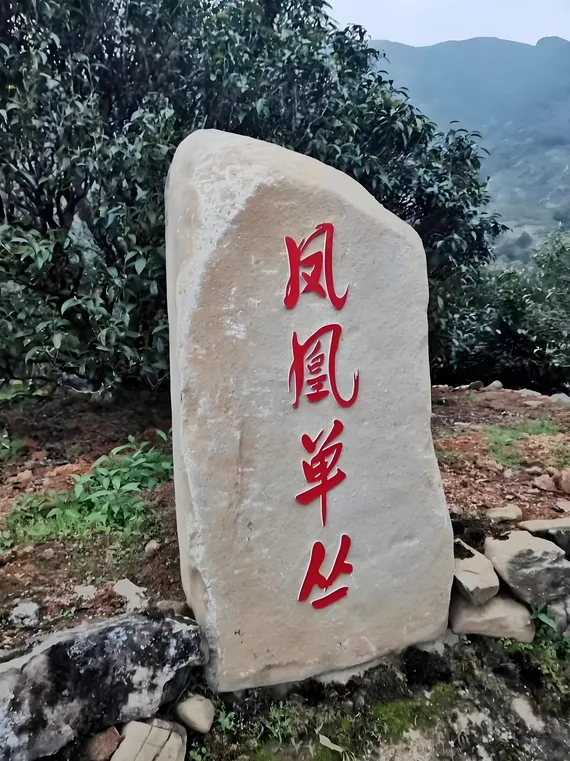
The name: why 丛, not 枞
The standard spelling is 凤凰单丛. 凤凰单枞 is a common typo for the same tea. In the Chaoshan dialect, 丛 is used in the sense of a plant or bush, which fits the old practice of tending, picking and making tea from distinctive trees on their own. 枞 names an evergreen conifer and has nothing to do with tea.
The mix-up is easy to explain. The characters are close in sound (丛 is second tone; 枞 is first), and the wood radical in 枞 makes it look as if it belongs in a plant name. You will still see 枞 on bags and shop signs.
Tea writers and local accounts widely report that in August 2004 the Chaozhou government instructed producers to use 丛 on packaging and in marketing. The later national geographical-indication title, however, is written 凤凰单丛(枞)茶, so both characters still appear in official product names. This article, like the site's existing guide, uses 丛.
Dan Cong is usually translated as "single bush." It comes from the old practice of processing outstanding trees separately. Modern Phoenix Dan Cong may also be made from groups of trees of the same cultivar or lineage, so a bag labelled Dan Cong may not come from one tree.
Heritage, and the legends around it
Tea growing in the Phoenix Mountains is often traced, in local tradition, to the Southern Song dynasty, some nine centuries ago. That dating belongs with the legends; it is not a firmly documented production history.
One story says that at the end of the Southern Song, the young emperor Zhao Bing, fleeing south, passed through Wudong Mountain, was offered a bowl of tea, and named it "Song tea." Later generations called that lineage Song Zhong. Another version says a phoenix, hearing that the emperor was thirsty, brought him a tea branch in its beak, which is why the tea has also been called "bird-beak tea." These are legends, not documentary history.
Written records of tea in the Chaozhou area become clearer in the Ming and Qing. A heritage account published by the China Agricultural Museum dates organized cultivation in Chao'an to 1547. By the late Qing, tea from the Phoenix Mountains and nearby Baihua (Dazhi) Mountain was already being noted in local gazetteers.
Old tea trees still stand in mid- and high-mountain villages, especially Wudong and Fengxi. Published counts vary with the age cutoff used. A 2021 national geography feature hosted by Xinhua puts the number of trees more than 200 years old at about 3,800.
What "perfume of teas" means
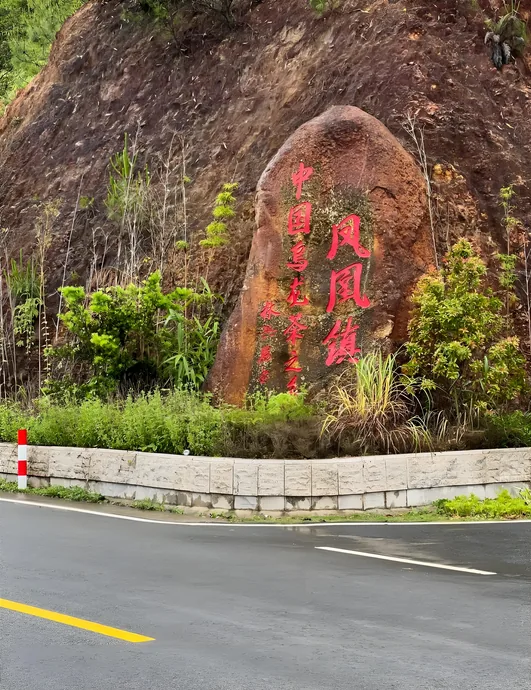
Phoenix Dan Cong is an oolong closely identified with Fenghuang Town, Chaozhou. In April 2010, China's former General Administration of Quality Supervision, Inspection and Quarantine approved geographical-indication protection for 凤凰单丛(枞)茶. The protected area is broader than a single town or mountain: it covers designated towns and tea districts in Chao'an, Raoping, Xiangqiao and Fengxi.
The original hallmark of the tea is single-bush processing. Farmers would choose a fine tree, pick it on its own and make the tea on its own. Over time that became the "one tree, one aroma" reputation.
Next to other oolongs, it is usually easy to recognize:
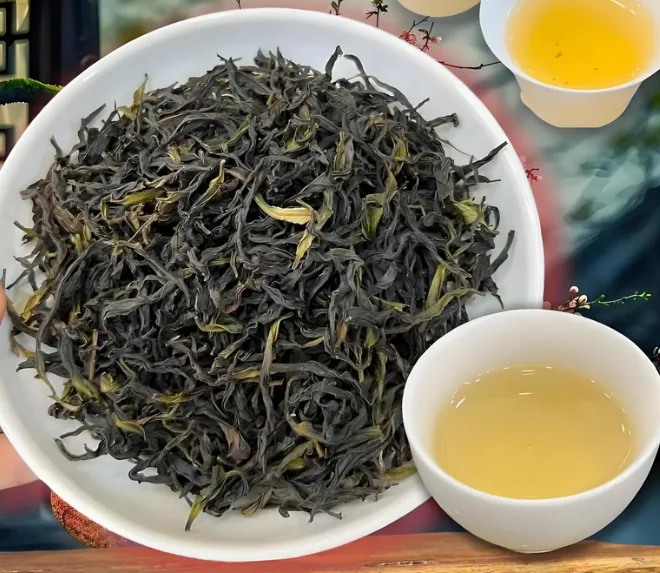
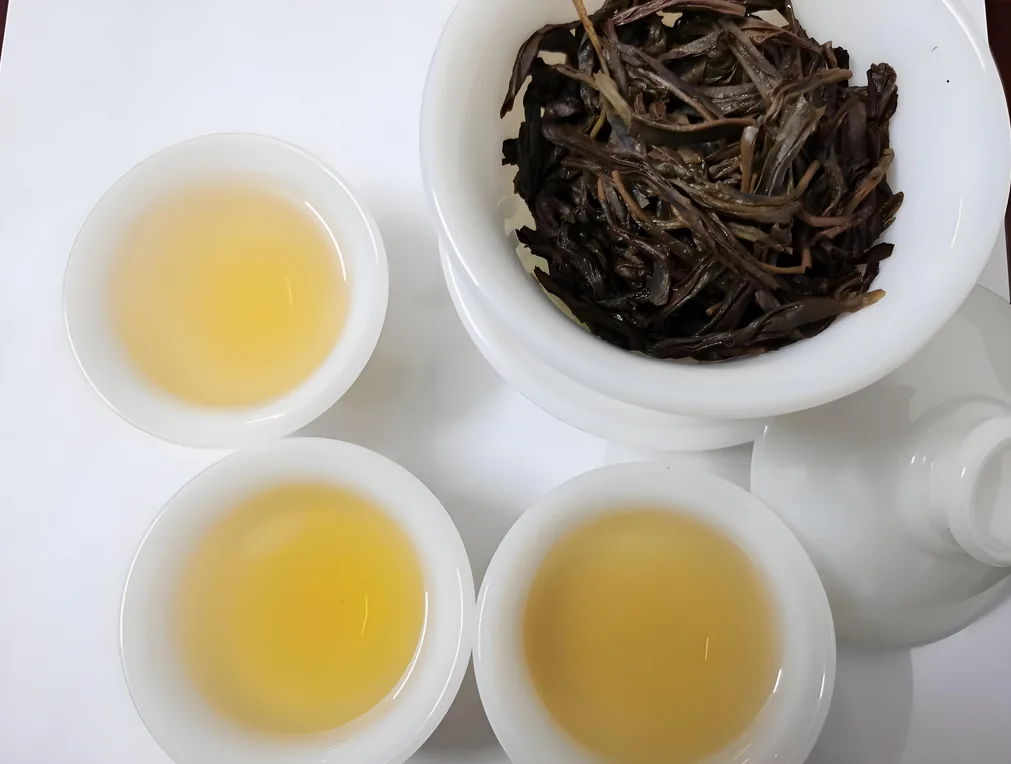
- The dry leaf is tightly twisted and sturdy, often with a glossy brown-red color.
- The liquor is bright gold, and the aroma is strong and lasting — floral, honeyed or fruity, depending on the tea.
- The taste is smooth, with a clear returning sweetness. A well-made batch can be infused many times and still leave some fragrance in the cup. That staying power is a large part of why people call it the "perfume of teas."
In an unflavored Phoenix Dan Cong, those floral, fruity and honey-like notes come from the leaf itself. They form during growth, oxidation and roasting. An aroma name is a hint, not a promise that flowers, honey or nuts were added.
The mountains behind the aroma
The character of the tea is tied to the Phoenix Mountains, sometimes called the "ridge of Chaoshan," north of Chaozhou. Xinhua's national geography feature gives the main peak, Fengniaoji (also called Wuji), as 1,497 meters, and Wudong, the second peak and the best-known tea mountain, as 1,391 meters. Other confirmed peaks in the same range include Dazhi (also known as Baihua or Daizhao Mountain) and Wanfeng. The tea is grown on these and other slopes, typically above about 500 meters.
Farmers and buyers often group the tea by elevation. This is a practical way of talking about the mountains, not a legal classification:
| Grade | Elevation | Character | Who it often suits |
|---|---|---|---|
| High-mountain tea | Above about 800 m (Wudong is the best-known example) | Cooler weather, a large day-night swing, frequent cloud and high humidity. The bushes grow slowly. The liquor is often thicker, the aroma more refined and lasting. | Drinkers looking for a more distinctive cup |
| Mid-mountain tea | About 400–800 m | A moderate climate and a more balanced growing season. Aroma and taste are often in proportion, and the value is frequently good. | Everyday drinking; a large share of what is sold |
| Low-mountain tea | Below about 400 m | Faster growth and more picking rounds. The aroma is usually lighter, bitterness a little more obvious, and the price more approachable. | An everyday starter tea |
The red and yellow soils drain well and hold minerals. Streams run through the hills, and the air stays humid enough for tea. That setting of mountains and water is one reason the tea can be so fragrant, full-bodied and durable in the pot.
Aroma traditions: the ten classic types
Named aromas run into the hundreds. These ten families are the classic way into the tradition. English translations vary, so it helps to keep the pinyin name when comparing teas. Mi Lan Xiang is a useful place to start tasting these names: the 2026 Wudong batch has honeyed and orchid notes.
| Aroma type | What you may notice | Representative names often cited |
|---|---|---|
| Huang Zhi Xiang (gardenia) | Clear gardenia; sweet, fresh and brisk | Da'an Song Zhong, Haidi Laozhen |
| Zhi Lan Xiang (orchid) | A refined sweet orchid; smooth and mellow | Baxian Guohai, Xiongdi Cha |
| Mi Lan Xiang (honey orchid) | The most widely sold classic: honeyed sweetness mixed with orchid | Baiye Dancong, Fanshu Xiang |
| Gui Hua Xiang (osmanthus) | A clean, sweet osmanthus; light and elegant | Qunti Dancong (a mixed-population / seedling Dan Cong) |
| Yu Lan Xiang (magnolia) | A rich magnolia fragrance and a fuller taste | Jin Yulan, Niangzai San |
| Jiang Hua Xiang (ginger flower) | A distinct ginger-flower note, a light spicy edge and a strong returning sweetness | Jiangmu Xiang, Tongtian Xiang |
| Ye Lai Xiang (night-scented floral) | A sweet, night-scented floral fragrance and a long finish | Ye Lai Xiang |
| Mo Li Xiang (jasmine) | A fresh jasmine-like aroma; sweet and clean | Mo Li Xiang |
| Xing Ren Xiang (almond) | The dry, roasted-almond smell of toasted nuts; rich and lasting | Ju Duo Zai (the leaf has fine serrations) |
| Rou Gui Xiang (cinnamon) | A sharp, cinnamon-like spice and a thick liquor | Rou Gui Xiang |
Ye Lai Xiang takes its name from a night-scented floral quality in the cup. The Chinese name 夜来香 is used for more than one garden plant, and local standards describe the tea by that fragrance without fixing a single botanical species.
A note on Ya Shi Xiang
Ya Shi Xiang sits outside the ten families and is one of the best-known Phoenix Dan Cong teas. It is also called Yin Hua Xiang, or Silver Flower aroma, because the fragrance can recall honeysuckle. The usual story is that growers nicknamed it "duck shit" after the local soil, hoping the unflattering name would keep the plants from being stolen.
The profile is floral rather than literally unsavory: a high, lasting aroma, often with almond, a creamy note and flowers. It should not be confused with "milk oolong." One example is our 2026 Wudong Ya Shi Xiang, with honeysuckle and naturally creamy notes.
Old bushes and young bushes
Another common grouping is by tree age:
- Old cong, often meaning trees more than about 50 years old: deeper roots, a thicker liquor, a more settled aroma and a sense of age in the cup. These teas usually cost more.
- Young cong, trees under that age: a fresher aroma, a cleaner taste and often better value for daily drinking.
Fifty years is a market convention, not a legal cutoff.
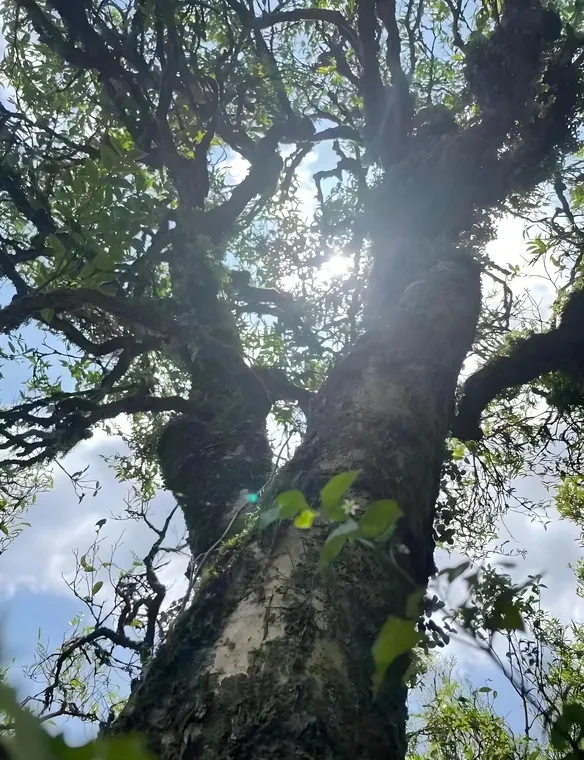
Across types, the tea is often summed up as high aroma, a full taste, good endurance in the pot and a long finish. The scent can remain after many infusions, the liquor is thick when the tea is well made, and the sweetness stays in the mouth.
Picking: season and leaf standard
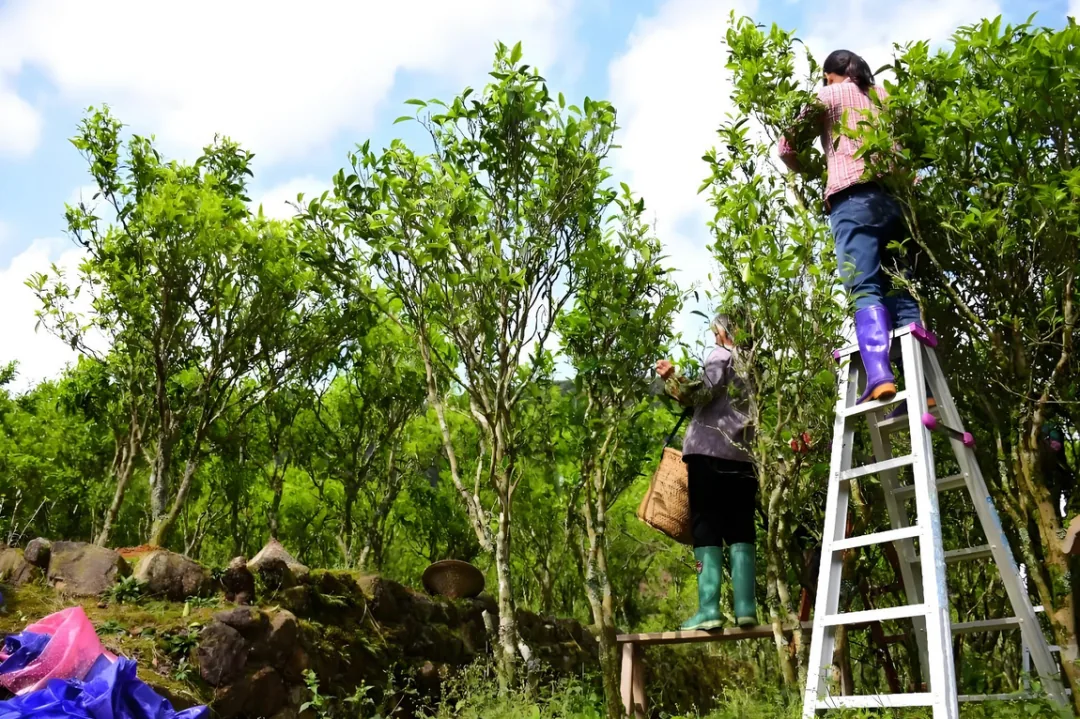
Phoenix Dan Cong is picked by hand, at the right time, from the right leaf. Season matters a great deal, and the plucking standard is tight.
| Season | When | Quality |
|---|---|---|
| Spring tea | Mid-to-late April through early May | Usually the best of the year. After the winter rest, the leaf is rich in substance. The liquor is thick, the aroma refined. High-mountain spring tea is treated as a prize lot. |
| Autumn tea | Around mid-September | Dry weather and a large day-night swing. The aroma shows clearly, the taste is clean. Second only to spring, and often good value. |
| Summer tea | July | Heat and rain, fast growth, less accumulated substance and a heavier bitter taste. Many farmers skip this pick. |
| Winter tea | Early November | Picked mainly in lower-elevation areas. A light aroma and a mild taste, suited to everyday drinking. |
If you want the highest quality, look first for high-mountain spring tea. For everyday drinking, autumn tea is a sensible choice.
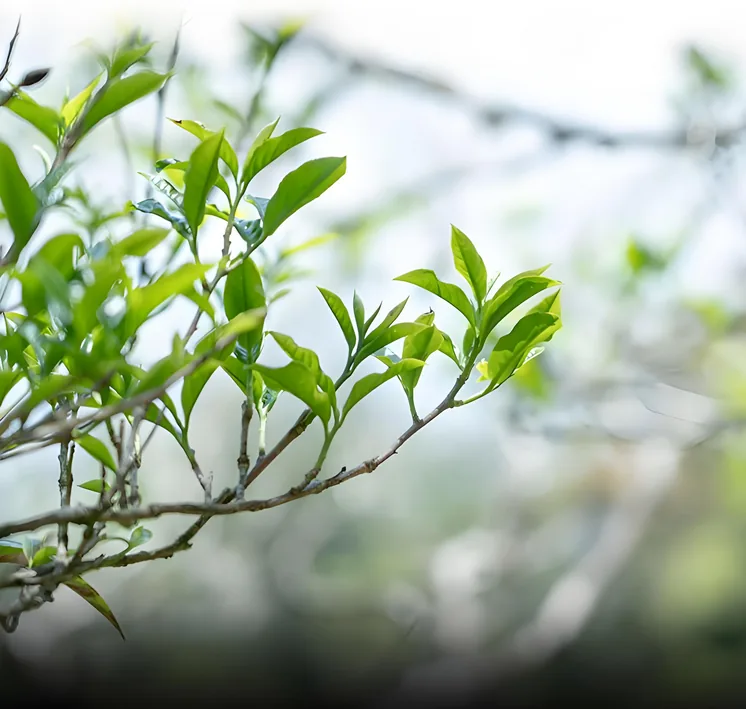
The usual standard is one bud with two leaves, sometimes one bud with three. Phoenix Dan Cong is not picked for extreme tenderness. The leaf needs to be mature enough to hold plenty of substance, but still soft enough for the later shaking and oxidation work.
The mainstream standard is one bud with two leaves, just opening or fully open: a full terminal bud and two fully expanded leaves, without scorched edges, in a deep or dark green. At that point the bud and leaves are in balance. The bud helps freshness; the leaves build fragrance and body.
One bud with three leaves is used only in small amounts, usually on high-mountain tea or older trees, and only if the third leaf has not toughened. Over-mature leaf can make the liquor bitter and the aroma dull.
What is not picked:
- One bud with one leaf. Too tender, not enough substance, easy to break during shaking, and a thin aroma.
- Old, diseased or damaged leaf. Yellowed leaves, insect spots, scorched edges or hard stems, which muddy both purity and taste.
- Rain-wet or dew-wet leaf. Water on the leaf can cause heating and spoilage in the basket. Wait until the surface moisture has gone.
How the tea is made
Half of the quality comes from the place, half from the work. Traditional processing follows a tight sequence. Shaking and resting the leaf (zuo qing) and the later roast are the steps that decide the most.
The early work is about handling the fresh leaf. It is picked by hand, mainly to the one-bud, two-leaf standard, then given a light wilt in the sun to drive off some moisture and start the aroma compounds moving. After that the leaf is spread indoors so the moisture evens out.
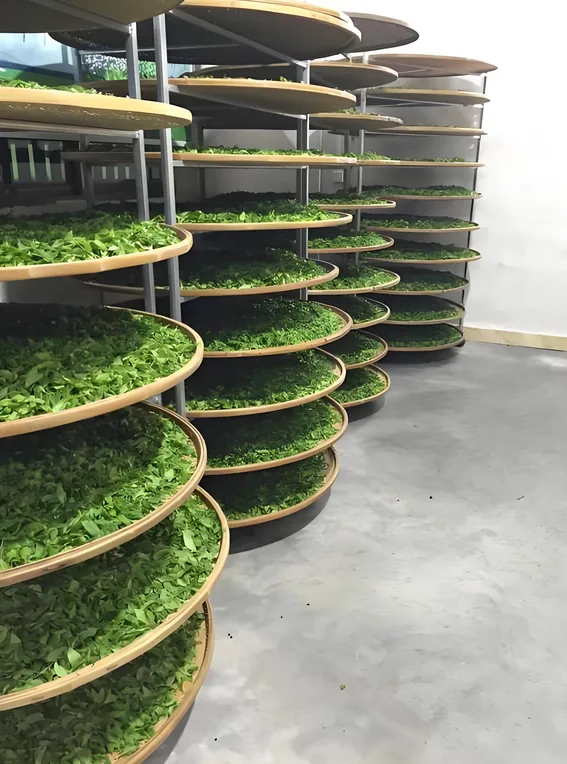
Zuo qing is the step that most depends on the maker's judgment. Shaking and resting alternate several times. Shaking bruises the leaf slightly so aroma can develop; resting lets the leaf "breathe" and transform. Too light a shake and the aroma stays faint; too heavy, and bitterness creeps in.
Fixation (sha qing) then stops oxidation and locks the aroma. Traditionally this is done in a high-heat iron wok; in many workshops today the leaf is also turned in a mechanical drum. Official accounts of Chaozhou Dan Cong processing give a wok temperature in the range of about 150–200°C. The leaf has to be moved quickly so it does not scorch. After that it is rolled into strips, so tea juices coat the surface and the tea releases more readily in the cup.
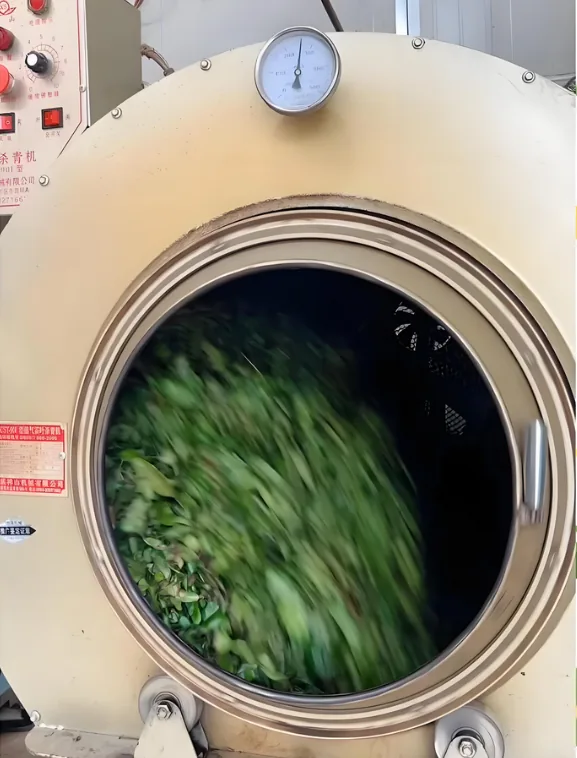
A slow, low charcoal roast — often described in the 50–80°C range — dries the leaf, transforms the aroma and eases bitterness. A light roast stays fresher and higher-pitched; a heavy roast is more settled and keeps better. Broken bits, stems and old leaf are then sifted and sorted out, and a second firing may be used to stabilize the tea for packing.
Brewing: pour off the liquor quickly
The main rule for brewing Phoenix Dan Cong is speed. The aroma is high, and a long first steep can turn the cup bitter.
A practical starting point in a gaiwan is about 8 g of leaf, filling the vessel about six- or seven-tenths full. Warm the ware first with boiling water. A rinse, if you use one, should be almost immediate. Pour boiling water in a high stream, just enough to cover the leaf, and pour off at once: about 3 seconds for the first infusion, 5 seconds for the second, and only gradually longer, still under 30 seconds by the sixth. There is no need to shake the dry leaf to "wake" the aroma; just cover it and pour.
Brewed this way, the liquor should stay clean, without a harsh bitter edge. For a fuller brewing guide, including the Chaozhou method and a longer steep in a mug or basket infuser, see How to brew Phoenix Dan Cong.
Like other tea from the Camellia sinensis plant, Phoenix Dan Cong contains caffeine. If you are sensitive, use less leaf and drink it earlier in the day. It is a tea to enjoy, not a medicine.
Keeping the aroma
The tea should be kept sealed, dry, cool, dark and away from strong smells. A foil-lined bag inside a clean tin or ceramic jar works well for daily use. Avoid the kitchen, the bathroom and perfume, and do not leave the container standing open.
A heavier roast generally keeps better than a very light one. Do not assume every roasted Dan Cong improves with age; roast level, moisture, packaging and storage all change how a batch develops. The existing guide has more on choosing and storing a first bag.
If you want help choosing a first Phoenix Dan Cong, or comparing aroma types when you buy, start with the complete Phoenix Dan Cong guide.